Please see http://www.bugscep.com/help for information on citing BugsCEP correctly.
|
A limited amount of summary data can be stored
for each site. This allows users to gain an small insight into the
meaning of the abundance data, and directs them to the references
for more information. BugsCEP is not intended to be a site database,
but rather a database of collection/sample data for sites.
|
- Activate the Site Manager from the main toolbar.
- Select a site from the list.
- Note that you can move to the first site begining with a
particular letter by pressing that key when the list is selected.
You can also sort the list by Site Name, Region or Country
by clicking on the column headers.
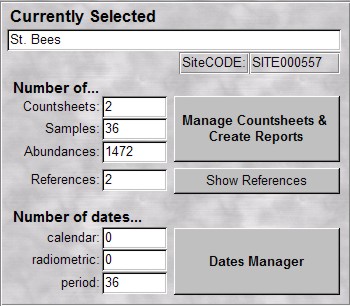
- A numerical summary of the data for the site will be shown in
the 'Currently Selected' panel on the right.
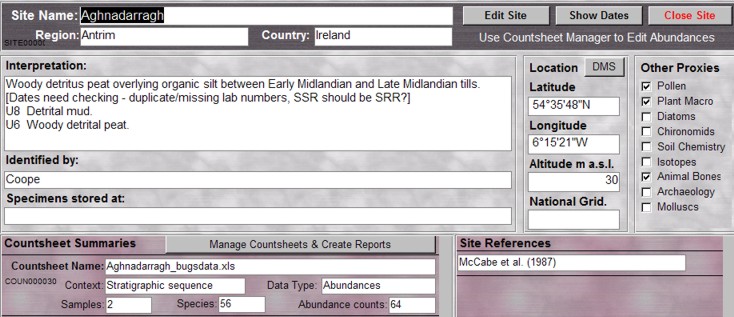
- Click the [Show Site Info.] button, and the summary information
for the selected site will be shown.
- The site information screen for Aghnadarragh in County Antrim,
Ireland* is shown
below. Abundance data is accessed through the [Manage Countsheets
& Create Reports] button.
|
|
|
|
| You can also access dating evidence for the site
from here through the [Show Dates] button. |
|
Countsheet (abundance) data
for a site |
All abundance data is stored as 'countsheets'
assigned to sites. A counsheet represents a cohesive sampling event
- for example, a sampling location at a site, or a pitfall trapping
excercise during a field season.
Users may of course decide how to define this for themselves.
|
- Open the Countsheet Manager for a site by either:
|
| |
Option 1 - From the Site
Manager |
| |
- Activate the Site Manager from the main toolbar.
- Select a site from the list.
- Click the [Manage Countsheets & Create Reports]
button.
(If there is no abundance data for the site you will be asked
whether you would like to add some).
|
| |
Option 2 - From the Site Information
screen |
| |
- Access the Site Information screen for a site from
either the Site Manager or from the fossil/site
record for a species on the main BugsCEP screen.
- Click the [Manage Countsheets & Create Reports]
button.
|
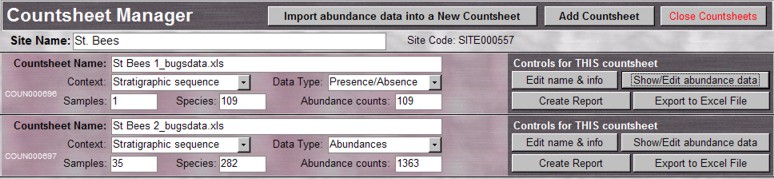
- The Countsheet Manager will display summary information for
all the sets of abundance data for the site. A countsheet is
simply a species list with an associated set of samples and abundance
values (or presence/absence).
In the example below the site St. Bees has two countsheets - one
with a single sample and presence/absence data for 109 taxa; and
another with 35 samples and abundance data for 282 taxa.
|
|
|
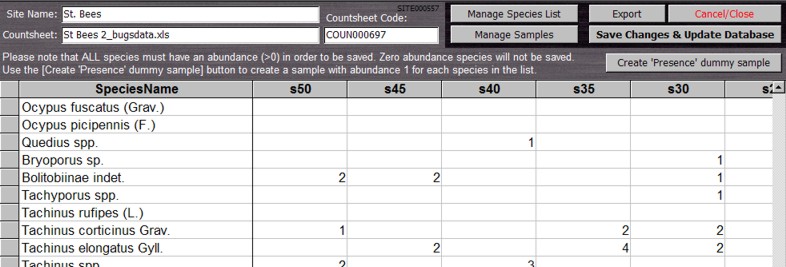
- Click the [Show/Edit abundance data] button for the countsheet
you wish to examine, and the Countsheet Editor will open with
the data in spreadsheet form.
|
|
|
|
Taxa are listed in the first column, and sample names displayed
in the remaining column headers. Cells show the abundance (or presence)
of each species in each sample.
At this point you can:
- export the countsheet to MS Excel by pressing the [Export] button
- edit the data
- see more sample details (coordinates & depths) by clicking
the [Manage Samples] button
- or return to the Countsheet Manager by pressing the [Cancel/Close]
button (and clicking [Yes] to the confirmation request] |
Site reports extract ecological
and bibliographic data for the species found at a site, in this way
replacing hours of literature searching, scanning, typing and cut
& paste with a few clicks and a number of seconds.
|
- Open the Countsheet Manager for the site (either from
the Site Manager or Site
Information Screen).
- Click the [Create Report] button next to the relevant countsheet.
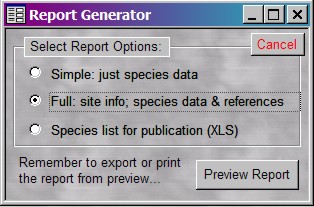
- The 'Report Generator' options window will pop up - select your
prefered report ('Full' is probably the most useful), and
press [Preview Report].
- After a few moments a preview of the report will be displayed,
from which you can print it, or export to MS Word or Excel with
the buttons on the toolbar.
|
|
| A word of warning: Site reports
can be very long - move to the last page before printing to
make sure you have enough paper! |
| The standard site reports will not give you a sample
by sample breakdown of the site - for that we recomend using the BugStats
module, accessible from the main toolbar. |
|
Examine dating evidence for a
site |
|
Samples stored in BugsCEP may be assigned any
number of dates (in years).
Three categories are catered for:
i) Calendar - specific dates, e.g. 49AD, 22BC, 1984AD
ii) Radiometric - C14, Uranium series etc. (anything that decays)
iii) Periods - broad categories, e.g. Late Glacial, Iron Age
If a resolution greater than a year is required
then this should be included in the Site Information data.
|
- Open the Dates Explorer for a site by either:
|
| |
Option 1 - From the Site
Manager |
| |
- Activate the Site Manager from the main toolbar.
- Select a site from the list.
- Click the [Dates Explorer] button.
|
| |
Option 2 - From the Site Information
screen |
| |
- Access the Site Information screen for a site from
either the Site Manager or from the fossil/site
record for a species on the main BugsCEP screen.
- Click the [Show Dates] button.
|
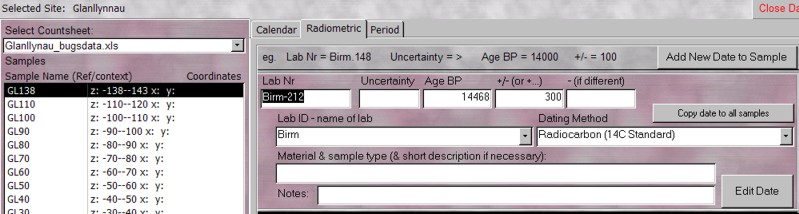
- The Dates Explorer lists samples for the selected countsheet
on the left. If a site has multiple counsheets you can switch
between them using the drop down box in the top left.
Dates for the selected sample are shown to the right - use the
tabs switch between date types.
|
 |
| |
|
Coope, G. R. (1977). Coleoptera as clues to the understanding of climatic
changes in North Wales towards the end of the last (Devensian) Glaciation.
Cambria, 4, 65-72.
Coope, G.R. & Brophy, J.A. (1972). Late Glacial environmental
changes indicated by a Coleopteran succession from North Wales. Boreas,
1, 97-142.
Coope, G.R. & Joachim, M.J. (1980). Lateglacial environmental
changes interpreted from fossil Coleoptera from St.Bees, Cumbria, N.W.England.
In J.J.Lowe, J.M.Gray & J.E.Robinson (eds.) Studies in the Lateglacial
of North-West Europe, 55-68. Pergamon, Oxford.
McCabe, A.M., Coope, G. R., Gennard, D. E. & Doughty, P. (1987).
Freshwater organic deposits and stratified sediments between Early and
Late Midlandian (Devensian) till sheets at Aghnadarragh, County Antrim,
Northern Ireland. Journal of Quaternary Science, 2, 11-34.
Pearson, R. G. (1962). The Coleoptera from a Late Glacial Deposit
at St. Bees, West Cumberland. Journal of Animal Ecology, 31, 129-150.
Simpkins, K. (1974). Late-glacial deposits at Glanllynau, Caernarvonshire.
New Phytologist, 72, 903-914.

|